There
are many good reviews of the Kawasaki W650 and rather than repeat
what they say, or give technical information, I want to describe why
I find this bike so wonderful to own. Much of what I have to say
should apply to the W800 too.
I
am editing this review in September 2014, and at this later time I
have owned my 2004 Kawasaki W650 for three years. I bought it used as
a grey import from Japan with 23,000km on the clock, and it now has
75,000km. I am in my late 30s and for most of my adult life I have
commuted daily through Melbourne, and toured the countryside on the
weekends, on a motorcycle. Hence I've owned a good number of bikes
and am prepared to criticise the short-comings of any of them. But of
the W650 I have, essentially, nothing negative to say! This can
be said of no other motorcycle that I have owned.
At
the time of purchase I was decided between the W and a Triumph
Bonneville, Harley Sportster or Royal Enfield. The W won based on
looks, feel and mechanical reputation. To list some of its virtues
from an owner's perspective, it has:
I
demand a lot of my motorcycling. It is said that to ride with others
is good for the heart and to ride alone is good for the soul.
Motorcycling refreshes my heart and soul. An important part of such
motorcycling is the bike itself. Professional bike reviewers are
often sports riders at heart and write from that perspective. They
focus on power and speed. Motorcycling is a very aesthetic experience
for me. A bike's distinctive character and looks, the visceral
experience that it provides, the imaginative associations it invites,
and the way it opens up the landscape to my senses, all get to the
heart of why I ride.
In
another post I review my old SR500. It was a wonderful bike. However
I have to admit that it was not quite comfortable on the highway,
which is a problem given that I enjoy riding long distances. Cue the
W650, which brings to the ride all the aesthetic qualities that I so
prized in the SR – sometimes to a greater degree - while being very
relaxed and capable on the highway.

What
is so charming about the W650 is what it evokes of
other motorcycles, as well as what it has of its own.
For
me the W650 evokes the motorcycles of the middle of the twentieth
century. Wrapped in my waxed-cotton jacket and gauntlets,
winding through green fields in winter, I feel like I am in a scene
from Heartbeat. But there is something deeper, too. Riding
is, for me, about being in, and moving through, places as an act of
appreciating not only what is before my eyes but also what my
imagination hints at. Think of how that tumbledown farmhouse
made you feel that time on an empty road. These imaginings have
a human-centred, historical sensibility – I like to ‘feel’ the
presence of people who once made their lives in this place and who
imprinted something of themselves on the landscape. To ride a
motorcycle that evokes the machines of past years is to be more
readily drawn into this imaginative sense of past things, to more
readily connect with this implicit aspect of the places through which
I ride. The W650 does this to a degree that few modern motorcycles
do. You only have to look at it to see what I mean. Of course it
would be best to ride an original machine from that era, but as a
mechanical simpleton I could never afford to keep such a machine on
the road (i.e. fund the mechanic) while doing the miles I do.
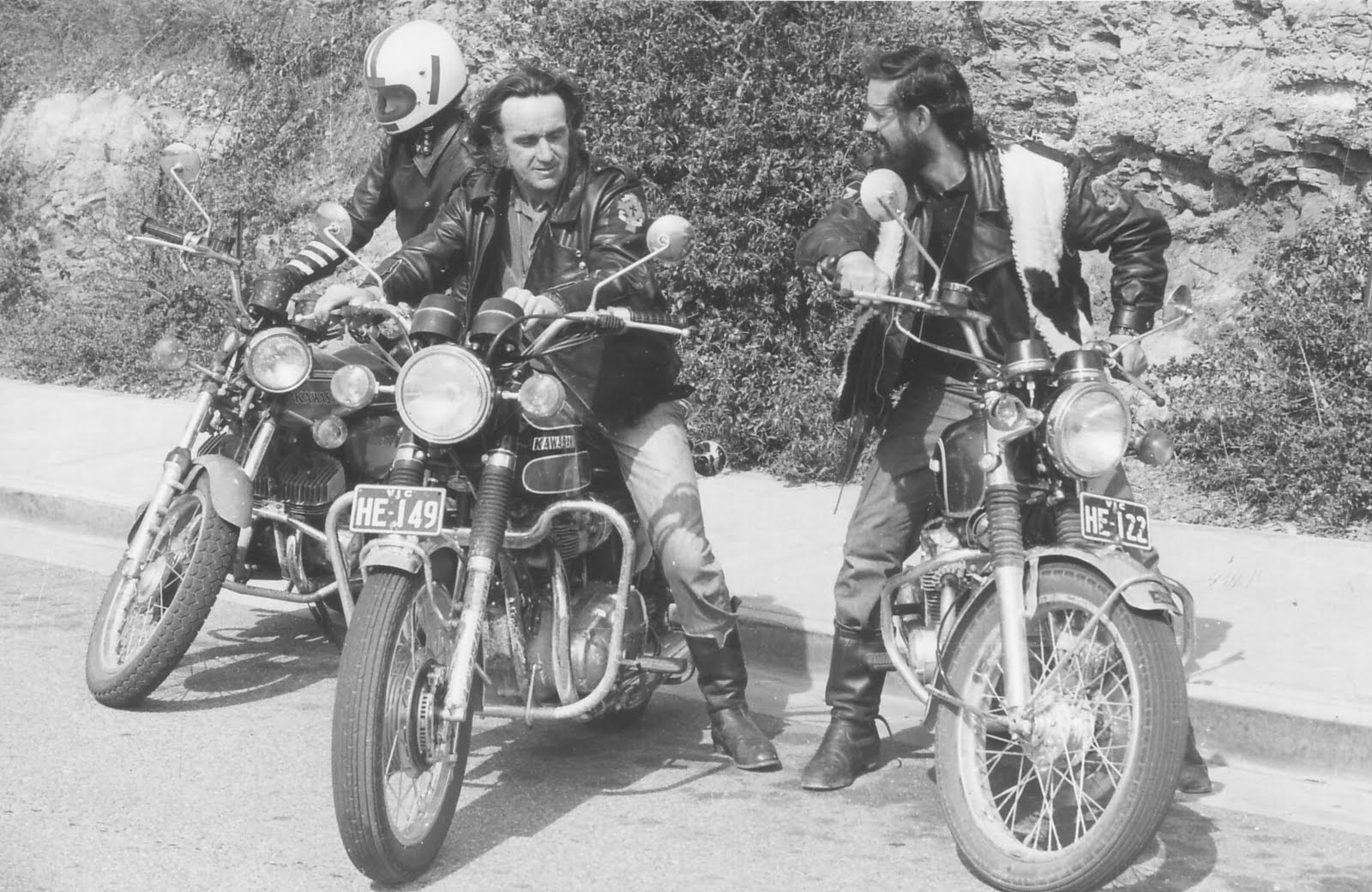
The
W650 has its own historical precedence. In the 1960s Kawasaki
manufactured the W1, a 650 twin which looked like a BSA – it
started out as a licensed 500cc BSA copy but evolved in Kawasaki’s
hands into a mechanically superior machine by the time it became
650cc. You can see one in the centre here (this is an old
Australian photo):
Kawasaki
pretends that their modern W650 is a remake of that, but we all know
it looks more like a 1960s Triumph Bonneville. This makes sense: if
you were to design a bike to evoke the great British twins, would you
not take inspiration from the model which many consider to be the
most beautiful and exciting?
The
W650 is clearly a retrospective motorcycle, a tribute, an evocation.
I think it achieves this aim better than its obvious competitor, the
new Bonneville. To me the new Bonnie looks like a 1970s UJM. Plus
its engine feels too smooth for my liking. And it is
unnecessarily complex to service the shims. Some people get
angry about the W, about others preferring it over the new Bonneville
(I had one fellow, a local, email me physical threats because of the
comments I just made). And this is interesting. Their attachment to
the Bonnie is to a British bike. However the Australian Bonnevilles
are made in Thailand. But what is most curious about their criticism
is the way in which it misses the point, for me at least. For me,
what I love about British bikes, alongside their cultural accretions,
is their beauty.
Retro, derivative, whatever, they have beauty in their own right.
Here is a subjective opinion with which some will disagree – I am
expressing my taste - but it seems that vehicles between the 1930s
and 1960s had a strong emphasis on aesthetics, and that from the
1970s onwards this has seemed to matter less to designers. I
think that the phenomenon of retro vehicles is driven by people's
desire for beauty. For art deco, for mirror chrome, for circles
and fins. And so what I appreciate in the W is not just the
fact that it reminds me of a 1960s British bike – although that is
an important part of its attraction – but equally that it is
beautiful in its own right.

So
how does it ride, this motorcycle which is both an evocation of an
era and a wonderful machine in its own right?
The
W650 has two different personalities. For the bike to evoke a
mid-century motorcycle it must have vibration, pulsation.
‘Silky-smooth’ and ‘sewing-machine-like’ do not describe
those old bikes. Kawasaki did a wonderful job of offering both
vibration from its long-stroke engine, as well as smoothness. The
smoothness is of two kinds in relation to the pulses. First, the
engine pulses are themselves smooth, as opposed to biting or harsh.
They are very present,
at the centre of the riding experience, which gives the bike a lot of
character, but they have a ‘rounded’ quality that makes them
pleasant. There is not that hard edge that makes you tense up. And so
the engine feels relaxed even as it’s thumping you up to speed.
That is the first kind of smoothness present in the W. Second, those
engine pulses are mostly dominant within a certain rpm-range, and
otherwise the engine is smooth in the sense of being without those
vibrations. On cue at 3000rpm the pulses start, they hit their climax
at 3,500rpm, then immediately beyond 4000rpm they smooth out and the
engine takes on a more calm purr. What this means is that you can
choose to ride in thumper-mode by remaining mostly in that rev-range,
or smooth mode by riding below (as I do in the city) or above it (as
I do on the highway). The other side of this story happens above
5000rpm. The W takes on a new character yet again – the
fire-breathing twin. It is a lot of fun up there, a place for
adrenalin on tight roads while overtaking cars.
I
will add a comment which was submitted to an earlier incarnation of
this review – thank you to Dave:
“I
have the 800; the only difference between the two engine is a slight
increase in the bore and the fuel injection. The 800 has more torque
at lower rpms - essentially flat from 2000rpm to 7000rpm redline and
maxing at 2500rpm rather than 5250 like the 650. The power is around
48hp @ 7000 compared to 50hp @ 7000 for the 650. The bike feels very
much like a late 60's Royal Enfield Interceptor as far as the engine
'feel' goes, albeit smoother. When new they do feel a bit dismal due
to the almost silent mufflers, but after about 10,000km they really
loosen up and a slight change to the baffles makes quite a bit of
difference to the feel, as I've found riding my modified bike and
unmodified ones. Wrenchmonkees in Denmark reckon they dynoed 90Nm @
3500 at the rear wheel with nothing more than pod filters and
different exhausts so it may be true.
They
are a lovely bike though. One of my main rides is a 1953 AJS 500 and
the feel of the two is quite similar oddly enough. The big
AJS/Matchless singles are quite smooth cruising up to about 90kmh and
with the same sort of pulsing.As mentioned though, over 4000rpm the
Kawasakis get very smooth and right on the old 360 degree twin
powerband. They really 'hammer' - no other word for it - above 5000
rpm and are a lot of fun playing boy racers in the twisties. Lovely
sound with the baffles done too.”
At
an indicated 100kph the bike sits on 3,500rpm in fifth gear. The W by
comparison feels utterly, unbelievably, beautifully relaxed at 100kph
in both fourth and fifth gear. Thanks to its lavish, even spread of
torque which begins just above 2000rpm, the W feels ‘in the zone’
in any gear at any rpm. There is little need to change gear through
the corners or when over-taking: I just open up the throttle and it
pulls away. I don’t even know what horespower the W is meant to
produce, and neither do I care – such specifications are all over
the web, but horespower has nothing to do with what is wonderful
about this bike.

With
over 50,000km under my belt on this bike I have never had to visit a
mechanic. I do all my own servicing on the footpath and it is very
simple. Even changing the shims is simple. Kawasaki have designed the
bike with servicing in mind. The W has, quite simply, given me no
trouble whatsoever. Well, at 75,000km I have two small cracks in the
rear fender. And the clutch sometimes (very rarely) slips when
dropped quickly at the lights on a cold engine. Tyres are cheap sizes
- about $350 for a pair here in Australia. The chain however is an
odd size which precludes buying a good one on sale. These bike have a
reputation for doing very high kilometers – in the hundreds of
thousands – without trouble, and I hope to ride mine until the
engine wears out and rebuild it.
I
am very, very happy with my W650. So much so that I would face a real
dilemma if mine needed replacing. For I would love to try owning
another motorcycle on my bucket list, but having owned one I am so
happy with this model, and feel so confident about its reliability,
that I suspect I will ride Ws for years to come.
If
you enjoyed this blog, please check out my other one, here.